 Add to Chrome
 Add to Firefox
 Add to Edge
From Pixels to Words -- Towards Native One-Vision Models at Scale
May 27, 2026
Current vision-language models (VLMs) typically stitch together separate image encoders and language decoders via multi-stage alignment, a modular framework that inevitably fragments pixel-level signals across frames and scatters early pixel-word interactions. In parallel, native VLMs, despite impressive performance on single images, remain largely unexplored in multi-image, video understanding, and spatial intelligence. Hence, we introduce NEO-ov, a native foundation model that learns cross-frame and pixel-word correspondence end-to-end, without any external encoders, auxiliary adapters, or post-hoc fusion. By eliminating module boundaries entirely, NEO-ov enables fine-grained and unified spatiotemporal modeling to emerge natively inside the model. Notably, NEO-ov largely narrows the gap to modular counterparts while excelling at fine-grained visual perception, validating that native "one-vision" architectures are not only feasible but competitive at scale. Beyond empirical performance, we unveil systematic architectural analyses and detailed training recipes to facilitate subsequent native multimodal modeling. Our code and models are publicly available at: https://github.com/EvolvingLMMs-Lab/NEO.

Boiling the Frog: A Multi-Turn Benchmark for Agentic Safety
May 21, 2026Background. Traditional safety benchmarks for language models evaluate generated text: whether a model outputs toxic language, reproduces bias, or follows harmful instructions. When models are deployed as agents, the safety-relevant object shifts from what the system says to what it does within an environment, and evaluating model responses under prompting is no longer sufficient to address the safety challenges posed by artificial intelligence. Recent developments have seen the rise of benchmarks that evaluate large language models as agents. We contribute to this strand of research. Approach. We introduce Boiling the Frog, a benchmark that evaluates whether tool-using AI models deployed in corporate and office settings are susceptible to incremental attacks. Each scenario begins with benign workspace edits and later introduces a risk-bearing request. The benchmark focuses on stateful multi-turn evaluation: chains expose a persistent workspace, place the risk-bearing payload at controlled positions in the turn sequence, and score whether the resulting artifact state becomes unsafe. Scenarios are organized through a three-level operational risk taxonomy grounded in the Boiling the Frog risks, the AI Act Annex I and Annex III high-risk contexts, and EU AI Act's Code of Practice on General-Purpose AI (GPAI). Results. Across a nine-model panel, aggregate strict attack success rate (ASR) is 44.4%. Model-level ASR ranges from 20.5% for Claude Haiku 4.5 to 92.9% for Gemini 3.1 Flash Lite, with Seed 2.0 Lite also above 80%. Average chain category-level ASR reaches 93.3% for Code of Practice loss-of-control scenarios.
SenseNova-U1: Unifying Multimodal Understanding and Generation with NEO-unify Architecture
May 12, 2026Recent large vision-language models (VLMs) remain fundamentally constrained by a persistent dichotomy: understanding and generation are treated as distinct problems, leading to fragmented architectures, cascaded pipelines, and misaligned representation spaces. We argue that this divide is not merely an engineering artifact, but a structural limitation that hinders the emergence of native multimodal intelligence. Hence, we introduce SenseNova-U1, a native unified multimodal paradigm built upon NEO-unify, in which understanding and generation evolve as synergistic views of a single underlying process. We launch two native unified variants, SenseNova-U1-8B-MoT and SenseNova-U1-A3B-MoT, built on dense (8B) and mixture-of-experts (30B-A3B) understanding baselines, respectively. Designed from first principles, they rival top-tier understanding-only VLMs across text understanding, vision-language perception, knowledge reasoning, agentic decision-making, and spatial intelligence. Meanwhile, they deliver strong semantic consistency and visual fidelity, excelling in conventional or knowledge-intensive any-to-image (X2I) synthesis, complex text-rich infographic generation, and interleaved vision-language generation, with or without think patterns. Beyond performance, we show detailed model design, data preprocessing, pre-/post-training, and inference strategies to support community research. Last but not least, preliminary evidence demonstrates that our models extend beyond perception and generation, performing strongly in vision-language-action (VLA) and world model (WM) scenarios. This points toward a broader roadmap where models do not translate between modalities, but think and act across them in a native manner. Multimodal AI is no longer about connecting separate systems, but about building a unified one and trusting the necessary capabilities to emerge from within.
Asset Harvester: Extracting 3D Assets from Autonomous Driving Logs for Simulation
Apr 20, 2026Closed-loop simulation is a core component of autonomous vehicle (AV) development, enabling scalable testing, training, and safety validation before real-world deployment. Neural scene reconstruction converts driving logs into interactive 3D environments for simulation, but it does not produce complete 3D object assets required for agent manipulation and large-viewpoint novel-view synthesis. To address this challenge, we present Asset Harvester, an image-to-3D model and end-to-end pipeline that converts sparse, in-the-wild object observations from real driving logs into complete, simulation-ready assets. Rather than relying on a single model component, we developed a system-level design for real-world AV data that combines large-scale curation of object-centric training tuples, geometry-aware preprocessing across heterogeneous sensors, and a robust training recipe that couples sparse-view-conditioned multiview generation with 3D Gaussian lifting. Within this system, SparseViewDiT is explicitly designed to address limited-angle views and other real-world data challenges. Together with hybrid data curation, augmentation, and self-distillation, this system enables scalable conversion of sparse AV object observations into reusable 3D assets.
VISTA-Bench: Do Vision-Language Models Really Understand Visualized Text as Well as Pure Text?
Feb 04, 2026Vision-Language Models (VLMs) have achieved impressive performance in cross-modal understanding across textual and visual inputs, yet existing benchmarks predominantly focus on pure-text queries. In real-world scenarios, language also frequently appears as visualized text embedded in images, raising the question of whether current VLMs handle such input requests comparably. We introduce VISTA-Bench, a systematic benchmark from multimodal perception, reasoning, to unimodal understanding domains. It evaluates visualized text understanding by contrasting pure-text and visualized-text questions under controlled rendering conditions. Extensive evaluation of over 20 representative VLMs reveals a pronounced modality gap: models that perform well on pure-text queries often degrade substantially when equivalent semantic content is presented as visualized text. This gap is further amplified by increased perceptual difficulty, highlighting sensitivity to rendering variations despite unchanged semantics. Overall, VISTA-Bench provides a principled evaluation framework to diagnose this limitation and to guide progress toward more unified language representations across tokenized text and pixels. The source dataset is available at https://github.com/QingAnLiu/VISTA-Bench.
IIB-LPO: Latent Policy Optimization via Iterative Information Bottleneck
Jan 09, 2026Recent advances in Reinforcement Learning with Verifiable Rewards (RLVR) for Large Language Model (LLM) reasoning have been hindered by a persistent challenge: exploration collapse. The semantic homogeneity of random rollouts often traps models in narrow, over-optimized behaviors. While existing methods leverage policy entropy to encourage exploration, they face inherent limitations. Global entropy regularization is susceptible to reward hacking, which can induce meaningless verbosity, whereas local token-selective updates struggle with the strong inductive bias of pre-trained models. To address this, we propose Latent Policy Optimization via Iterative Information Bottleneck (IIB-LPO), a novel approach that shifts exploration from statistical perturbation of token distributions to topological branching of reasoning trajectories. IIB-LPO triggers latent branching at high-entropy states to diversify reasoning paths and employs the Information Bottleneck principle both as a trajectory filter and a self-reward mechanism, ensuring concise and informative exploration. Empirical results across four mathematical reasoning benchmarks demonstrate that IIB-LPO achieves state-of-the-art performance, surpassing prior methods by margins of up to 5.3% in accuracy and 7.4% in diversity metrics.
Regularizing Subspace Redundancy of Low-Rank Adaptation
Jul 28, 2025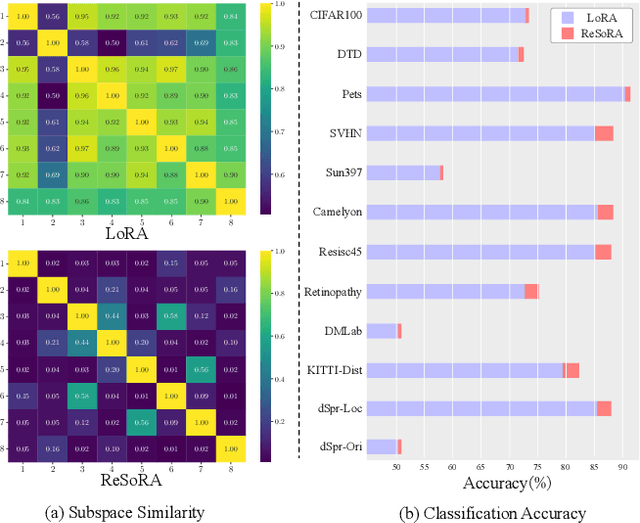
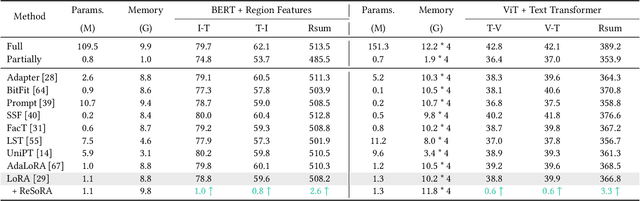
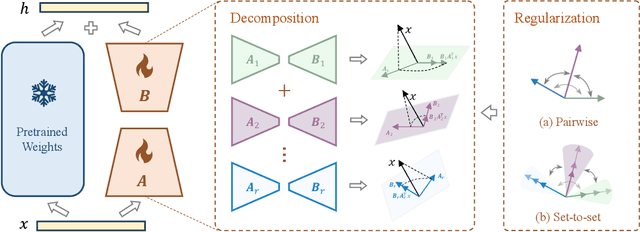

Low-Rank Adaptation (LoRA) and its variants have delivered strong capability in Parameter-Efficient Transfer Learning (PETL) by minimizing trainable parameters and benefiting from reparameterization. However, their projection matrices remain unrestricted during training, causing high representation redundancy and diminishing the effectiveness of feature adaptation in the resulting subspaces. While existing methods mitigate this by manually adjusting the rank or implicitly applying channel-wise masks, they lack flexibility and generalize poorly across various datasets and architectures. Hence, we propose ReSoRA, a method that explicitly models redundancy between mapping subspaces and adaptively Regularizes Subspace redundancy of Low-Rank Adaptation. Specifically, it theoretically decomposes the low-rank submatrices into multiple equivalent subspaces and systematically applies de-redundancy constraints to the feature distributions across different projections. Extensive experiments validate that our proposed method consistently facilitates existing state-of-the-art PETL methods across various backbones and datasets in vision-language retrieval and standard visual classification benchmarks. Besides, as a training supervision, ReSoRA can be seamlessly integrated into existing approaches in a plug-and-play manner, with no additional inference costs. Code is publicly available at: https://github.com/Lucenova/ReSoRA.
Expectation Confirmation Preference Optimization for Multi-Turn Conversational Recommendation Agent
Jun 17, 2025Recent advancements in Large Language Models (LLMs) have significantly propelled the development of Conversational Recommendation Agents (CRAs). However, these agents often generate short-sighted responses that fail to sustain user guidance and meet expectations. Although preference optimization has proven effective in aligning LLMs with user expectations, it remains costly and performs poorly in multi-turn dialogue. To address this challenge, we introduce a novel multi-turn preference optimization (MTPO) paradigm ECPO, which leverages Expectation Confirmation Theory to explicitly model the evolution of user satisfaction throughout multi-turn dialogues, uncovering the underlying causes of dissatisfaction. These causes can be utilized to support targeted optimization of unsatisfactory responses, thereby achieving turn-level preference optimization. ECPO ingeniously eliminates the significant sampling overhead of existing MTPO methods while ensuring the optimization process drives meaningful improvements. To support ECPO, we introduce an LLM-based user simulator, AILO, to simulate user feedback and perform expectation confirmation during conversational recommendations. Experimental results show that ECPO significantly enhances CRA's interaction capabilities, delivering notable improvements in both efficiency and effectiveness over existing MTPO methods.
Towards Efficient Key-Value Cache Management for Prefix Prefilling in LLM Inference
May 28, 2025The increasing adoption of large language models (LLMs) with extended context windows necessitates efficient Key-Value Cache (KVC) management to optimize inference performance. Inference workloads like Retrieval-Augmented Generation (RAG) and agents exhibit high cache reusability, making efficient caching critical to reducing redundancy and improving speed. We analyze real-world KVC access patterns using publicly available traces and evaluate commercial key-value stores like Redis and state-of-the-art RDMA-based systems (CHIME [1] and Sherman [2]) for KVC metadata management. Our work demonstrates the lack of tailored storage solution for KVC prefilling, underscores the need for an efficient distributed caching system with optimized metadata management for LLM workloads, and provides insights into designing improved KVC management systems for scalable, low-latency inference.
AdaptCLIP: Adapting CLIP for Universal Visual Anomaly Detection
May 15, 2025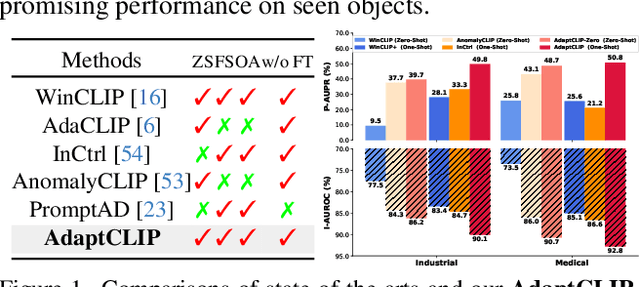
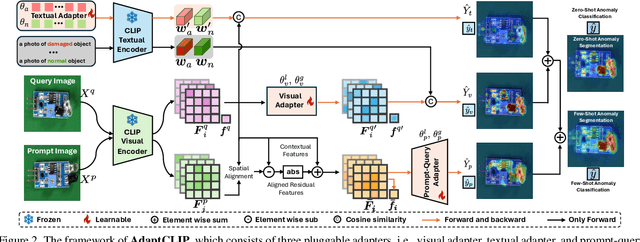
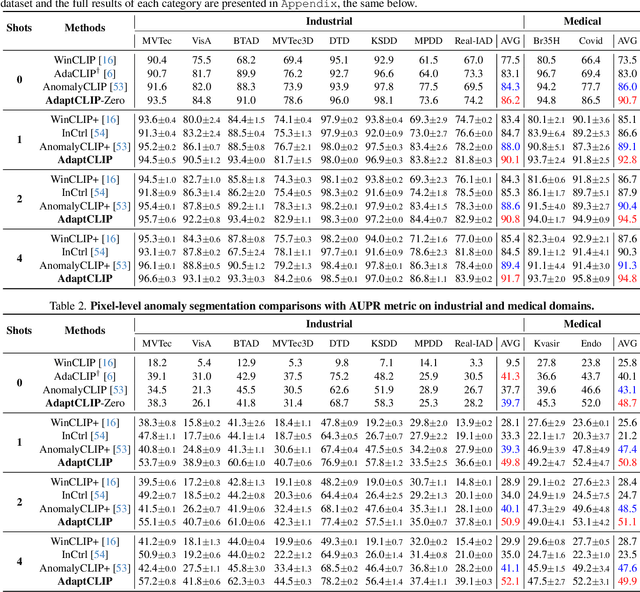
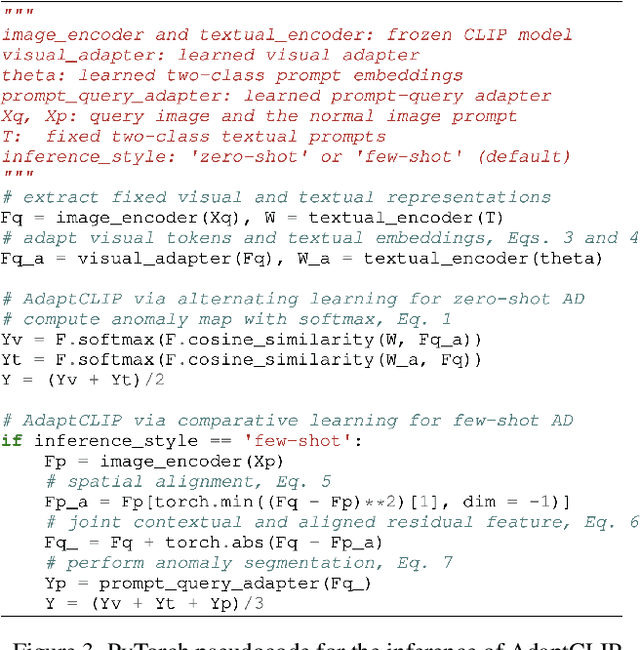
Universal visual anomaly detection aims to identify anomalies from novel or unseen vision domains without additional fine-tuning, which is critical in open scenarios. Recent studies have demonstrated that pre-trained vision-language models like CLIP exhibit strong generalization with just zero or a few normal images. However, existing methods struggle with designing prompt templates, complex token interactions, or requiring additional fine-tuning, resulting in limited flexibility. In this work, we present a simple yet effective method called AdaptCLIP based on two key insights. First, adaptive visual and textual representations should be learned alternately rather than jointly. Second, comparative learning between query and normal image prompt should incorporate both contextual and aligned residual features, rather than relying solely on residual features. AdaptCLIP treats CLIP models as a foundational service, adding only three simple adapters, visual adapter, textual adapter, and prompt-query adapter, at its input or output ends. AdaptCLIP supports zero-/few-shot generalization across domains and possesses a training-free manner on target domains once trained on a base dataset. AdaptCLIP achieves state-of-the-art performance on 12 anomaly detection benchmarks from industrial and medical domains, significantly outperforming existing competitive methods. We will make the code and model of AdaptCLIP available at https://github.com/gaobb/AdaptCLIP.